One 1975 Rule Change That Silently Raised Every Index Fund Expense Ratio

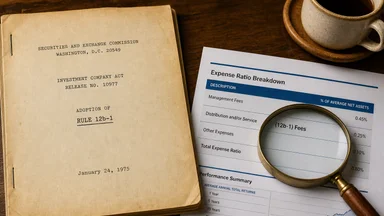
Every investor knows the drill: look for low expense ratios, favor index funds, and let compounding do the rest. But a quiet regulatory shift in 1975 has been working against that advice for decades, adding a layer of cost that most fund holders never notice. SEC Rule 12b-1, introduced with little fanfare, allowed mutual funds to take money from shareholder assets to pay for marketing and distribution. What was sold as a temporary growth tool became a permanent tax on returns, even for supposedly low-cost index funds.
The 1975 Rule That Made Your Fund Costlier
In October 1975, the Securities and Exchange Commission adopted Rule 12b-1 under the Investment Company Act of 1940. The rule permitted mutual funds to use fund assets—money belonging to shareholders—to cover expenses related to the sale and distribution of fund shares. This included broker commissions, advertising, and sales literature. Before 1975, such costs were typically borne by the fund's investment adviser or paid through front-end loads, not deducted from the fund's ongoing assets.
The rule emerged during a period of regulatory change. The early 1970s saw the rise of no-load funds, which bypassed traditional broker networks and offered lower upfront costs. Traditional brokers argued they needed compensation for the ongoing service they provided to fund investors. Rule 12b-1 was framed as a compromise: funds could pay brokers a small annual fee from assets, rather than a large one-time commission. The SEC intended it as a temporary measure to help funds attract new investors and grow to a size where economies of scale would reduce overall costs.
In practice, the temporary measure never expired. Once a fund adopted a 12b-1 plan, it rarely eliminated it. The fee became a fixture of the fund's expense ratio, typically ranging from 0.25% to 1.00% annually. By the 1980s, 12b-1 fees were widespread. A 1992 SEC report noted that over 60% of funds charged them. Today, roughly 80% of mutual funds impose some level of 12b-1 fee, according to Morningstar data as of late 2024.
The justification for the rule always hinged on growth. New assets would lower per-share costs, benefiting all shareholders. But critics, including Vanguard founder John Bogle, argued that the fee was simply a hidden sales commission. Bogle called it a “tax on investors” that undermined the core promise of low-cost investing. A 2010 SEC study found little evidence that 12b-1 fees actually benefited shareholders, noting that funds with high 12b-1 fees did not have lower overall expense ratios or better performance.
How a Marketing Fee Became an Expense Ratio Staple
Today, 12b-1 fees are embedded in the expense ratios of thousands of mutual funds. The average 12b-1 fee across all funds that charge it is roughly 0.25% annually, according to the Investment Company Institute. That may seem small, but over a 30-year investment horizon, a 0.25% annual fee consumes about 7% of the ending portfolio value. For a $100,000 investment earning 6% annually, that is roughly $13,000 lost to the fee alone.
The fee is especially insidious because it is often invisible. Most investors focus on the total expense ratio, not its components. A fund with a 1.00% expense ratio might include a 0.25% 12b-1 fee, but the prospectus buries this detail in fine print. Even “no-load” funds—those that do not charge a sales commission at purchase—can still charge 12b-1 fees. The term “no-load” is misleading; it only means the fund does not charge a front-end or back-end load, but it may still deduct ongoing distribution fees from assets.
The SEC has attempted to address the confusion. In 2010, it proposed a rule to cap 12b-1 fees at 0.25% and require clearer disclosure, but the rule was never finalized. In 2018, the SEC floated a broader repeal of the rule, arguing that modern brokerage practices—such as commission-free trading and fee-based advisory accounts—had made the fee obsolete. The brokerage industry pushed back, warning that eliminating 12b-1 fees would disrupt the way many funds compensate brokers. The repeal never took effect.
The persistence of 12b-1 fees reflects a fundamental tension in the fund industry. Advisers and brokers need compensation for selling funds, but shareholders bear the cost. As long as the fee is buried in the expense ratio, investors have little incentive to shop for lower-cost alternatives. A 2023 study by the Brookings Institution estimated that 12b-1 fees cost U.S. investors roughly $10 billion annually, a sum that flows largely to broker-dealers rather than improving fund performance.
Index Funds Weren't Spared—They Were Shaped by It
When the first index fund for individual investors—Vanguard's First Index Investment Trust—launched in 1976, it struggled to attract assets. The fund was a radical idea: simply track the S&P 500 and charge minimal fees. But distribution was a challenge. Vanguard, then a small upstart, lacked the broker network that established fund families used to sell shares.
To grow, Vanguard used Rule 12b-1. The fund adopted a 12b-1 plan in the early 1980s, using the fees to pay brokers and financial advisors who recommended the fund to clients. The strategy worked: assets climbed, and the fund eventually reached the scale needed to lower its expense ratio. By the 1990s, Vanguard's index fund expense ratio had fallen to roughly 0.20%, far below the industry average. But the 12b-1 fee remained, even after the fund no longer needed it to attract assets.
Today, many older index funds still carry 12b-1 fees. For example, a major S&P 500 index fund from a large fund family may charge a 0.25% 12b-1 fee as part of its 0.50% expense ratio. Meanwhile, newer exchange-traded funds (ETFs) tracking the same index often charge 0.03% or less, with no 12b-1 fee. The difference is stark: the older mutual fund costs investors roughly 10 times more than the ETF, largely because of the legacy 12b-1 fee.
ETFs generally avoid 12b-1 fees because they trade on exchanges like stocks, and brokers earn commissions on trades rather than ongoing asset-based fees. But some ETFs do charge 12b-1 fees, particularly those sold through advisor platforms that bundle services. Investors should check the prospectus: if an ETF lists a 12b-1 fee, it is often a sign that the fund is distributed through traditional broker channels rather than direct-to-investor or exchange-based platforms.
The Rule That Never Delivered on Its Promise
The original justification for Rule 12b-1 was that it would help funds achieve economies of scale, ultimately lowering costs for all shareholders. The logic was straightforward: if a fund could attract more assets through marketing, its fixed costs (like administration and portfolio management) would be spread over a larger base, reducing the per-share expense ratio. The 12b-1 fee was supposed to be a temporary investment that would pay off in lower fees later.
In practice, that rarely happened. A 2010 study by the SEC's Office of Investor Education and Advocacy examined fund expense ratios over time and found that funds with 12b-1 fees did not reduce their overall expense ratios as assets grew. Instead, the fees remained stable or increased. The SEC concluded that “12b-1 fees have not resulted in lower costs for fund shareholders.” Other research, including a 2015 analysis by Morningstar, found that funds with high 12b-1 fees underperformed low-fee peers, partly because the fee itself dragged down returns.
Morningstar's data suggests that a 1.00% 12b-1 fee (the maximum allowed) can consume roughly 20% of a fund's total return over a 30-year period, depending on market conditions. For a fund earning 6% annually, a 1.00% fee reduces the net return to 5%, which over 30 years cuts the ending balance by about 23%. The fee is particularly damaging in low-return environments, where every basis point matters.
Regulators have repeatedly considered repealing or reforming the rule. In 2018, the SEC proposed a rule that would have eliminated 12b-1 fees altogether, replacing them with a simpler, more transparent fee structure for broker compensation. The proposal drew fierce opposition from the brokerage industry, which argued that 12b-1 fees were an established part of the fund distribution system and that eliminating them would disrupt the way many small investors access funds. The SEC ultimately shelved the proposal. As of early 2025, the rule remains in effect.
How to Spot the Hidden Fee in Your Portfolio
Finding 12b-1 fees in your fund holdings is not difficult, but it requires looking in the right place. The fee is disclosed in the fund's prospectus, usually in a table titled “Annual Fund Operating Expenses.” Look for a line item labeled “Distribution and/or Service (12b-1) Fees.” If the amount is anything other than zero, the fund is charging you for marketing and distribution, regardless of what the fund's name or category suggests.
Many investors assume that “no-load” funds do not charge 12b-1 fees, but that is not always true. A fund can be no-load—meaning it does not charge a front-end or back-end sales load—while still deducting up to 0.25% annually in 12b-1 fees under the NASD (now FINRA) cap for no-load funds. So a fund labeled “no-load” may still cost you 0.25% more than a similar fund without the fee. Always verify the actual expense ratio components, not just the load status.
Exchange-traded funds are generally a safer bet. Most ETFs do not charge 12b-1 fees because they are structured differently; they trade on exchanges and brokers earn commissions on trades rather than ongoing fees. However, some ETFs, especially those that are part of a fund family's share class for advisor-sold accounts, may include a 12b-1 fee. Check the ETF's prospectus or use tools like Morningstar's fee analyzer, which breaks down expense ratios into management fees, 12b-1 fees, and other costs.
Comparing expense ratios across similar funds is another way to spot the hidden fee. For example, an S&P 500 index fund with a 0.50% expense ratio likely includes a 12b-1 fee, while a comparable ETF might charge 0.03%. The difference of 0.47 percentage points is almost entirely due to the 12b-1 fee and other distribution costs. Over 30 years, that difference can amount to tens of thousands of dollars, depending on the investment size. Tools like FINRA's Fund Analyzer allow investors to compare the long-term impact of fees between funds.
For those who prefer to avoid the fee entirely, the simplest solution is to choose ETFs or index funds from providers that do not use 12b-1 plans. Vanguard, for instance, has phased out 12b-1 fees on most of its investor share classes, though some legacy funds still carry them. Fidelity and Schwab also offer low-cost index funds and ETFs with no 12b-1 fees. As always, read the prospectus carefully before investing.
What a Repeal Would Mean for Your Retirement
If regulators ever succeed in repealing Rule 12b-1, the impact on investors could be substantial. Estimates from the Investment Company Institute suggest that eliminating 12b-1 fees would save U.S. mutual fund shareholders roughly $10 billion annually. That figure is based on current 12b-1 fee collections across all funds. For a typical investor with $100,000 in mutual funds charging an average 0.25% 12b-1 fee, the annual saving would be about $250—modest in any given year, but significant over a lifetime.
The compounding effect of fee reduction is well documented. A 1% reduction in annual fees can boost an investor's final portfolio balance by roughly 20% over a 30-year period, assuming a 6% annual return. For a $100,000 initial investment with no additional contributions, that means roughly $20,000 more at retirement. Even a 0.25% reduction—the average 12b-1 fee—can add about 5% to the ending balance, or roughly $5,000 in this example.
Of course, a repeal would face fierce resistance. The brokerage industry has long argued that 12b-1 fees compensate advisors for ongoing services, such as helping clients rebalance portfolios or choose funds. Without these fees, brokers might shift to fee-based advisory accounts, which could cost investors more or less depending on the account size and usage. The transition would be complex, and some investors could end up paying more in other ways.
Individual investors do not have to wait for regulators. The shift toward low-cost ETFs and commission-free trading has already put pressure on 12b-1 fees. Many fund families have reduced or eliminated them on newer share classes. By choosing funds without 12b-1 fees, investors can avoid the hidden cost today. The rule may survive, but the market is slowly making it less relevant. For now, the best defense is a careful read of the prospectus and a preference for funds that put your money to work, not toward marketing.
This article is for informational purposes only and does not constitute personalized investment advice. Always consult a qualified financial professional before making investment decisions.