Seven Tbilisi Mornings Measuring Khachapuri Price by Street Corner and Baker’s Oven Heat

In Tbilisi, the price of khachapuri is not a fixed number. It shifts with the hour, the street corner, and the heat of the oven behind the counter. A visitor who pays the first asking price will overpay, and one who buys too early will eat a cold, sad version of Georgia's most famous bread. Over seven mornings of walking, waiting, and paying attention, a clear pattern emerges: the best khachapuri is the one that is baked in front of you, sold by weight, and eaten within minutes of leaving the oven.
Khachapuri Prices Vary More by Hour Than by Neighborhood
On a Tuesday morning in the residential district of Saburtalo, a small bakery near the Technical University metro station sells Imeretian khachapuri for the equivalent of about 1.50 lari before 8 a.m. By 10 a.m., the same loaf, same size, costs 2 lari. The baker, a woman named Nino who has worked there for eleven years, explains that early loaves are made to move quickly, while later batches are priced for the lunch rush.
The pattern repeats across the city. Bakeries near metro stations, especially at Rustaveli and Marjanishvili, charge a premium of 20 to 30 percent over similar shops on side streets. The difference is not quality. It is foot traffic. A tourist who steps off the metro and buys the first khachapuri they see pays for convenience, not for better bread.
Old town corners, particularly along the tourist spine near Sioni Cathedral, double prices. A khachapuri that costs 2 lari in a residential bakery can reach 4 or 5 lari in a cafe with a terrace facing the street. The same dough, the same cheese, but the view is added to the bill. Locals rarely buy there, and the staff expect foreigners to pay more.
Local bakeries often sell by weight, not by unit. A tray of khachapuri is weighed, and the price is calculated on a scale. This is common in markets like the Dezerter Bazaar, where vendors cut a piece from a larger loaf. Tourists who assume a fixed price per piece may be surprised, but the per-kilo rate is usually lower than the per-piece rate at a bakery that pre-packages.
The price gap narrows sharply by 9 a.m. By then, the early loaves are gone, and the later batches are priced the same across most of the city. A traveler who waits until mid-morning will pay roughly the same amount whether they buy near a metro or on a quiet street. The lesson is simple: if you want cheap and fresh, go early. If you want convenience, pay the difference.
Baker's Oven Heat Signals Freshness Better Than Any Label
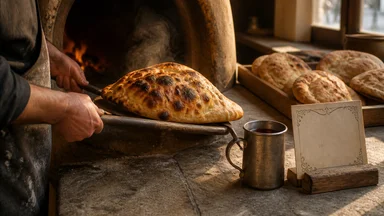
In Tbilisi, freshness is not a claim printed on a wrapper. It is visible in the oven. A good bakery has a visible oven, often a traditional tone, a cylindrical clay oven set into the counter. Watch for steam rising when a new batch is pulled out. That steam is the first sign that the khachapuri was baked minutes ago, not hours.
At Bakery Lagidze on Rustaveli Avenue, the baker, a man named Giorgi, demonstrates the technique. He slides a round of dough into the tone with a swift motion, then uses a metal hook to pull out the finished loaf exactly seven minutes later. The crust is blistered and dark in spots, and steam rises in a plume. He taps the top, and it crackles. "Fresh," he says, and wraps it in a piece of paper. That sound is the second sign of freshness: the crust crackles as it cools. If you tap the top and it sounds hollow and crisp, it is likely fresh. If it sounds dense or soft, it may have been sitting for a while.
Ask for 'tskhali' khachapuri, which means 'hot' in Georgian. Most bakers understand this phrase, even if you do not speak the language. They will point to the oven or nod. If they hesitate, it may mean the next batch is not ready. A good bakery will tell you to wait five minutes rather than sell you a cold one.
Cold trays are a warning. If you see khachapuri stacked on a tray at room temperature, with no steam and no crackle, it is likely reheated stock. Reheating destroys the texture of the cheese and the crispness of the crust. Some bakeries will put a cold khachapuri in the oven for a minute, but that does not restore the original bake.
Charred edges are a good sign, not a defect. A few dark spots on the crust indicate high oven heat, which is what creates the chewy interior and the crisp exterior. A pale, evenly colored khachapuri may have been baked at a lower temperature, which often results in a doughy center. Local bakers take pride in a slight char, and they will tell you so if you ask.
Payment Realities: Cash Still Rules the Early Morning
In the early morning, cash is king in Tbilisi's bakeries. The large chain bakeries, like the ones near shopping centers, accept cards. But the small kiosks and family-run shops that bake the best khachapuri often do not have card terminals. A traveler who plans to eat where locals eat should carry lari, the local currency, in small denominations.
ATMs near metro exits dispense lari, and most accept foreign cards. However, the machines near tourist areas sometimes run out of cash by mid-morning on weekends. It is safer to withdraw the night before or early in the day. The exchange rate at ATMs is generally fair, but be cautious with currency exchange booths that advertise 'zero commission' at the airport; they may give worse rates, so it is wise to compare with a bank rate or check online before exchanging.
Small bills are essential. A 10-lari note is too large for a 1.50-lari khachapuri. Bakers often do not have change for large notes, especially in the first hour of business. They may round up or ask you to come back later. Carrying 1-lari and 2-lari coins makes transactions smooth and avoids awkward moments.
Some stalls round up without offering change. This is not a scam, but it is a common practice when the customer cannot provide exact change. A khachapuri priced at 1.80 lari may be rounded to 2 lari, and the vendor will not mention it. If you hand over a 5-lari note, expect change in coins, but do not be surprised if the amount is slightly less than the exact total.
Hygiene Cues Locals Actually Use, Not the Tourist Checklist
Tourists worry about the wrong things. They look for gloves and hairnets, but locals look at hands. A baker with flour-dusted hands is a good sign; it means they are actively working with dough. A baker who wears gloves but never touches the dough might be more concerned with appearance than with the process.
Watch where money is placed. A good bakery keeps a separate dish or a designated spot for money, away from the food. If the baker takes your bill and then reaches for the bread without washing or wiping, that is a cue to look elsewhere. Locals notice this, and they avoid stalls where money and food mix.
The smell of fresh oil is a better indicator than bleach. A bakery that smells of clean, hot oil is likely using fresh ingredients. A strong bleach odor may mean the surfaces are clean, but it can also mask a lack of ventilation or old grease. Trust your nose over a checklist of cleaning products.
Flies near the cheese are a deal-breaker. In the summer, markets can attract flies, but a reputable baker keeps the cheese covered or in a display case. If you see flies landing on the sulguni, move on. Locals will not buy from a stall where the cheese is exposed, no matter how good the bread looks.
Seven Mornings, Seven Different Khachapuri Styles
Khachapuri is not a single dish. Each region of Georgia has its own version, and Tbilisi, as the capital, offers them all. Over seven mornings, a traveler can taste the range without leaving the city.
Start with the Adjarian khachapuri, the boat-shaped one with an egg and butter in the center. It is the most famous, and it is best eaten hot, with the egg still runny. Find a bakery that specializes in this style, often near the Old Town, and go early. The price can be higher, but the experience is worth it.
Imeretian khachapuri is the everyday version, a round, flat bread with cheese inside. It is the most common and the cheapest. A good Imeretian khachapuri has a golden crust and a generous filling of sulguni, the local cheese. It is the benchmark for price and quality.
Megrelian khachapuri is like Imeretian but with extra cheese on top, baked until it bubbles and browns. It is richer and often more expensive. Look for it in bakeries near the central market, where Megrelian bakers have set up shop.
Kubdari is a mountain style, from the Svaneti region. It is a bread stuffed with spiced meat, usually pork or beef. It is less common in Tbilisi, but some bakeries in the outskirts make it. It is a heavier breakfast, best saved for a day when you plan to walk a lot.
Sweet khachapuri, with fruit fillings like cherry or apricot, is a dessert version. It is not traditional for breakfast, but it appears in some bakeries in the afternoon. If you have a sweet tooth, try a small piece. It is a good way to understand how the dough adapts to different fillings.
What to Skip: The Tourist-Trap Bakeries and Overpriced Cafes
Cafes near Freedom Square charge triple for khachapuri, and the quality is often no better than a street bakery. A khachapuri that costs 2 lari in the suburbs can be 6 lari at a cafe with a view of the square. The markup is for the location, not the food. Skip these places unless you want to pay for a seat.
Pre-wrapped khachapuri loses texture. Some bakeries wrap each loaf in plastic for convenience, but the steam condenses and makes the crust soggy. A khachapuri that is stored in a paper bag is better, but the best is one that is handed to you straight from the oven, wrapped in a piece of paper or a napkin.
Skip stalls with English menus only. A bakery that caters exclusively to tourists may not have the same standards as a local shop. The menu might be translated, but the prices are often inflated, and the bread may be baked in a central kitchen and delivered, not made on site.
Avoid stalls with no visible oven. If you cannot see the oven, you cannot judge freshness. A bakery that bakes in the back and brings out trays may be fine, but it is harder to verify. The best khachapuri is made in front of you, and you can watch the baker slide the dough into the tone.
Do not buy before 8 a.m. if the trays are still cold. Some bakeries start baking at 6 a.m., but others do not have their first batch ready until 8:30. If you walk in and the khachapuri looks pale and cold, ask when the next batch is coming. It is better to wait twenty minutes than to eat a disappointing breakfast.
Building a Humane Khachapuri Crawl: Three Days, Not a Checklist
A khachapuri crawl does not need to be a marathon. Three days, with three or four stops each, is enough to taste the range without exhausting yourself. The key is to pace the tasting and to pair each khachapuri with something to drink, like tea or coffee, to balance the richness.
Day one: start near a metro station. Pick a bakery within a five-minute walk of a station like Technical University or Delisi. Have an Imeretian khachapuri and a strong coffee. This is the baseline. Note the price and the texture. Then, in the afternoon, walk to a different neighborhood and compare. The difference will be noticeable.
Day two: wander residential streets, away from the tourist landmarks. Look for a bakery with a visible tone and a queue of locals. Try a Megrelian khachapuri, which is richer, and a glass of matsoni, a local yogurt drink, to cut the fat. This is the day to observe how bakers work and to ask about the styles.
Day three: try a mountain-style bakery, either kubdari or a sweet khachapuri. These are less common, so you may need to ask around or travel a bit further from the center. The effort is worth it, because these styles are rarely found in tourist areas. Finish the morning with a strong tea and a slow walk.
Pace yourself. Khachapuri is filling, and eating too many in one morning will ruin your appetite for the rest of the day. A single khachapuri, shared with a friend or eaten alone, is enough for a breakfast. Save the extra tastings for lunch, or take a piece to eat later. The bread keeps for a few hours, though it is best fresh.
Save lunch for a sit-down meal. A khachapuri crawl is a breakfast activity. For lunch, find a proper restaurant and order a full Georgian meal, with salads, grilled meats, and a bottle of wine. The contrast between the street food and the sit-down meal is part of the experience. It also gives your stomach time to recover.
The crawl is not a competition. It is a way to see the city through its most common food. Some mornings will be better than others, and some bakeries will disappoint. That is fine. The goal is not to find the perfect khachapuri but to understand how a city feeds itself. So, as you plan your own crawl, ask yourself: what will you look for in the oven's glow, and which street corner will you choose to start your morning?