401k Income Rider That Collects Fees on a Balance You No Longer Own


Imagine paying a fee on money you no longer have. That is the reality for some retirees who hold a variable annuity with an income rider inside their 401k. The rider, sold as a way to guarantee lifetime income, carries an annual charge calculated not on the account's actual value but on a separate figure called the benefit base. When markets fall or withdrawals drain the account, the benefit base can remain high—or even grow—while the real balance shrinks. The fee keeps coming, deducted from whatever value remains, and in some cases continues even after the account hits zero. This article traces how that fee structure works, who benefits, and what alternatives exist.
The Fee That Outlives the Balance
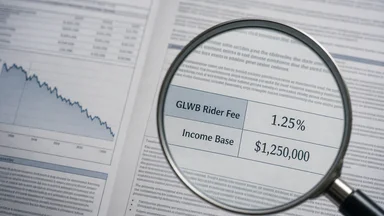
An income rider is an optional add-on to a variable annuity. It promises a stream of income for life, no matter how the underlying investments perform. To fund that promise, the insurance company charges an annual rider fee. The fee is typically calculated as a percentage of the benefit base—a notional value that the insurer uses to determine your income payments.
The benefit base often starts equal to your initial investment. But it can increase through a guaranteed roll-up rate—commonly 5% to 7% per year—regardless of how your actual investments perform. Meanwhile, your account value fluctuates with the market. In a prolonged downturn, the account value can fall far below the benefit base. The rider fee, however, continues to be charged on the larger benefit base.
Consider a retiree who invested $100,000 and, after a decade of market losses and withdrawals, sees the account value drop to $20,000. If the benefit base has grown to $150,000 through roll-ups, a 1.25% rider fee means $1,875 annually—charged against that $20,000 account. The fee effectively consumes 9% of the remaining value each year, accelerating depletion.
The fee is deducted quarterly from the account value. If the account value is too small to cover the fee, the insurer may deduct it from future withdrawals or add it as a negative balance. Some contracts allow the fee to continue even after the account reaches zero, collected from any future income payments or credited as a debt against the policy.
This dynamic is not limited to extreme scenarios. Even in moderate market conditions, the gap between benefit base and account value can widen gradually. A retiree who takes regular withdrawals to cover living expenses will see the account value decline faster than the benefit base, especially if the roll-up rate exceeds the withdrawal rate. Over a 20-year retirement, the cumulative fee drag can be substantial, reducing the total income received by tens of thousands of dollars compared to a low-cost alternative.
How the Benefit Base Inflates
The benefit base grows through two mechanisms: roll-up rates and step-ups. A roll-up rate is a guaranteed annual increase, say 6%, applied to the benefit base regardless of market returns. Step-ups occur when market gains increase the account value above the benefit base, locking in the higher amount. In theory, step-ups can benefit the retiree, but they also raise the fee base.
In a flat or declining market, only the roll-up applies. Over 10 years, a 6% roll-up nearly doubles the benefit base—from $100,000 to roughly $179,000. If the account value stays flat or falls, the gap between the two widens. The rider fee, now calculated on $179,000, grows accordingly.
This design creates a perverse incentive. The insurer earns more fees when the benefit base is large, even if the account value is small. The retiree pays for a guarantee that may never be fully used, especially if the account is depleted before income withdrawals begin.
Morningstar's 2023 analysis of variable annuity fees found that income riders typically add 1.0% to 1.5% to the total annual expense. On a benefit base of $200,000, that translates to $2,000 to $3,000 per year. Over 20 years, cumulative fees can exceed $40,000, even if the account value never reaches that level.
To illustrate the compounding effect, consider a retiree who invests $200,000 at age 65 and delays income withdrawals until age 70. During those five years, a 6% roll-up increases the benefit base to roughly $267,000, while the account value might grow only modestly if invested conservatively. The rider fee, charged annually on the benefit base, accumulates to around $16,000 over five years—all before any income is taken. That $16,000 is deducted from the account value, reducing the pool available for future withdrawals.
The Annual Fee Bite
The rider fee is just one layer of costs. Variable annuities also carry mortality and expense charges, administrative fees, and underlying fund expenses. Total annual expenses often range from 2.5% to 4.0% of account value. Adding a 1.25% rider pushes the total toward 4% or more.
Because the rider fee is based on the benefit base, not the account value, its effective percentage of the account value can be much higher. If the account value is $50,000 and the benefit base is $150,000, a 1.25% rider fee equals $1,875—or 3.75% of the actual account. Combined with other fees, the total annual drag can exceed 6% of the account value.
This fee structure is disclosed in the contract's fee table, but the language is dense. The rider fee is listed as a percentage of the benefit base, with a note that the benefit base may differ from the account value. Many retirees do not fully grasp the implication until they see their statement.
A 2021 study by the Consumer Financial Protection Bureau found that annuity riders are among the most misunderstood product features. Nearly half of surveyed annuity owners did not know that fees could be charged on a notional amount larger than their account balance. The study recommended clearer disclosures, but industry adoption has been slow.
Consider a concrete example: a retiree with a $300,000 account value and a $400,000 benefit base. The rider fee at 1.25% is $5,000 per year, which is 1.67% of the account value. Adding mortality and expense charges of 1.2%, administrative fees of 0.3%, and fund expenses averaging 0.8% brings total annual costs to roughly 4.0% of account value—or $12,000 per year. Over a 25-year retirement, that cumulative cost exceeds $300,000, assuming the account value stays constant in nominal terms. In reality, the account value declines as fees are deducted, so the total cost is even higher in present value terms.
When the Account Hits Zero
The most extreme scenario occurs when the account value is depleted entirely. This can happen through a combination of market losses, withdrawals, and fees. At that point, the rider fee has no real balance to draw from. Yet the fee may still be charged.
Some contracts allow the insurer to deduct the fee from future income payments. Others create a negative account balance, effectively a debt that must be repaid before any future withdrawals or transfers. The fee continues to accrue on the benefit base, which remains positive as long as the rider is active.
Consumer Reports highlighted a case where a retiree's account hit zero after years of fees and withdrawals. The rider fee, still calculated on a $120,000 benefit base, was deducted from the next month's income check, reducing it by roughly $125. The retiree effectively paid for a guarantee that no longer covered any account value.
Industry defenders argue that the rider fee supports the lifetime income guarantee, which remains valuable even after the account is empty. The insurer must still make payments, possibly for decades. But critics note that the fee structure front-loads costs and can accelerate depletion, making it harder for the account to last.
This trade-off is central to the debate: is the guarantee worth the fee, even after the account is gone? For a retiree who lives longer than average, the answer may be yes—the insurer continues paying income for life. But for those who die earlier, the fees paid may far exceed the benefits received. The product is essentially a longevity hedge, but one where the cost is uncertain and can be substantial.
Who Benefits from This Design
The insurance company benefits most directly. The rider fee provides a steady, predictable revenue stream that is largely independent of market performance. Because the benefit base is designed to grow, fees increase over time, even if the account value does not. This creates a built-in hedge for the insurer.
Agents also benefit. Commissions on income riders are often higher than on the base annuity, typically 1% to 2% of the premium upfront. Some contracts pay trailing commissions on the rider fee. A $200,000 policy can generate $4,000 in first-year commissions for the agent, with ongoing trails of 0.25% annually.
Product complexity works in the industry's favor. Few retirees comparison-shop across insurers or between annuity and non-annuity income strategies. The fee structure is buried in prospectuses and contract riders. A 2023 report from the Government Accountability Office found that annuity disclosure forms often exceed 50 pages, with key fees scattered across sections.
Regulatory filings show high persistency rates for income riders—meaning most buyers keep them for years, even when the account value shrinks. The combination of sunk cost, fear of losing the guarantee, and difficulty evaluating alternatives keeps retirees locked in.
Another beneficiary is the annuity platform provider. Many 401k plans offer annuities through third-party vendors that charge platform fees on top of the rider fee. These fees are often hidden in the plan's expense ratio and can add 0.5% to 1.0% annually. The total cost to the retiree can easily exceed 5% of account value per year, making it one of the most expensive retirement income options available.
Alternatives That Don't Charge on Air
One alternative is a no-rider variable annuity, which strips out the income guarantee and its associated fee. The retiree instead manages withdrawals manually, using a systematic withdrawal plan. Total expenses drop to roughly 1.5% to 2.5% of account value, without the notional base complication.
A single-premium immediate annuity (SPIA) offers a straightforward trade: a lump sum in exchange for fixed monthly payments for life. There is no benefit base, no roll-up, and no fee on a phantom balance. The cost is embedded in the payout rate, which is transparent at purchase. The downside is loss of liquidity and no inflation adjustment unless purchased as a rider.
For those who want market exposure without annuity costs, a ladder of index funds combined with a bond ladder can provide similar income with lower fees. A fee-only financial advisor can model the breakeven between a rider-based strategy and a DIY approach, accounting for taxes and withdrawal rates.
Another option is a registered index-linked annuity (RILA) with a guaranteed lifetime withdrawal benefit but capped fees. Some RILAs offer income riders with lower annual charges, around 0.5% to 0.75% of the benefit base. However, the same risk of fee-on-phantom-base applies, though the lower percentage reduces the bite.
For retirees who already own a rider and are unhappy with the fees, surrender may be an option, though often with penalties. Some contracts allow a free-look period of 30 days after purchase. After that, surrender charges can be steep—typically 7% to 10% of the account value in the first year, declining over time. A careful cost-benefit analysis is needed before exiting.
What to Ask Before Buying
Before purchasing an income rider, ask for the fee schedule in dollar terms, not just percentages. Request a projection showing the rider fee each year alongside the projected account value and benefit base, assuming a flat market. This reveals how quickly fees can consume the account.
Simulate a scenario where the account value hits zero after five years of withdrawals. Ask the agent: Does the fee end when the account ends? Will the fee be deducted from future income payments? Get the answer in writing.
Compare the rider cost against the expected income boost. An income rider might increase the guaranteed withdrawal rate from 4% to 5% of the benefit base. If the rider fee is 1.25% of the benefit base, the net benefit is only 3.75%—less than a standard 4% withdrawal from a low-cost portfolio. Run the numbers with realistic assumptions.
Read the contract's "Fee and Charges" section carefully. Look for language about the benefit base, how it is calculated, and whether fees can be charged after the account value reaches zero. If the language is unclear, ask for a plain-English explanation. Consider paying a fee-only advisor for an independent review before signing.
Finally, consider whether the guarantee is worth the cost at all. For many retirees, a combination of Social Security, a pension, and a systematic withdrawal from a low-cost portfolio can provide sufficient income without the complexity and fees of an income rider. The peace of mind from a guarantee may be valuable, but it comes at a price that is often higher than expected.
This article is for informational purposes only and does not constitute personalized financial advice. Consult a qualified professional before making any investment decisions.