Checking Account Terms That Charge You for Depositing Your Own Money

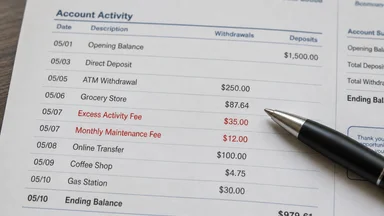
You open a checking account expecting a safe place to hold your cash. You deposit your paycheck, pay bills, and maybe earn a little interest. But buried in the account agreement are terms that can turn a routine deposit into a fee event. Banks call them "excess activity fees," "monthly maintenance fees," or "early closure penalties." They are not advertised on the branch window. They show up on your statement, often without warning.
This article walks through the most common checking account fees that effectively charge you for depositing or keeping your own money. It explains who sets these rules, why they exist, and how you can avoid them. The goal is not to scare you away from banks—it is to make the fine print legible so you can choose an account that works for you.
The Fine Print That Turns a Deposit into a Fee
Excess activity fees are one of the most surprising charges in consumer banking. They apply when you exceed a certain number of deposits, withdrawals, or transactions in a given month. Some accounts cap monthly deposits at as few as 25 items. Go over that limit, and the bank charges a fee—typically in the range of $10 to $15 per occurrence. That means each extra deposit, whether a check, a cash deposit, or a transfer, costs you money.
The logic from the bank's perspective: processing deposits costs them money. A high volume of small transactions, especially in a branch or via a teller, requires staff time and system resources. Rather than raise account fees across the board, they use excess activity fees to discourage heavy users. But for the customer, the effect is perverse—you pay for depositing your own earnings.
Some banks set the limit low enough to catch ordinary users. A small business owner who deposits daily cash receipts, or a freelancer who receives multiple client checks, can hit the cap within the first two weeks of a month. The fee then applies to every subsequent deposit, creating a cascade of charges that can total $100 or more in a single billing cycle.
Credit unions and online banks are less likely to impose this fee, but not all of them. It pays to read the fee schedule before opening an account, not after the first charge appears. Look for language like "excess transaction fee" or "deposit limit fee." If you cannot find it in the account agreement, call the bank and ask directly.
Consider a concrete example: a freelance graphic designer might receive five to ten client payments per week via check or electronic transfer. If the bank's limit is 25 deposits per month, the designer could hit that cap by the middle of the month. Each subsequent deposit might trigger a $12 fee. By month's end, the designer could rack up $60 to $100 in excess activity fees—money that effectively reduces their income. For a small business owner making daily cash deposits from a coffee shop, the situation is even worse. A limit of 30 deposits per month could be exceeded within the first week if they deposit cash each day. The resulting fees can eat into thin profit margins.
Who Sets These Rules and Why
Banks are for-profit businesses. Fee income is a significant part of their revenue. According to industry data, overdraft and service fees alone generate tens of billions of dollars annually for U.S. banks. Excess activity fees and monthly maintenance fees are smaller pieces of that pie, but they add up. When interest rates are low, banks lean harder on fee income to maintain margins.
Regulatory capital rules also play a role. Banks must hold a certain amount of capital against deposits, especially those that are volatile or high-volume. A customer who makes 50 deposits a month is more expensive to serve than one who makes 5. The bank's risk models treat high-volume accounts as costlier, and the fees are a way to pass that cost back to the customer. It is not exactly a "haircut" on deposits—the finance term for the discount applied to collateral—but the idea is similar: the bank assigns a higher risk weight to your account and charges you for it.
Overdraft protection is another trigger for extra charges. Many banks offer overdraft protection that links your checking account to a savings account or line of credit. If you overdraw, the bank transfers funds automatically. But that transfer often incurs a fee—typically around $10 to $12 per transfer. If a deposit is held due to availability delays, and you have a pending withdrawal, the overdraft protection kicks in and the fee follows. You end up paying for the bank's own delay in making your funds available.
Some economists argue that these fees are a form of price discrimination. Customers who are less attentive or less able to switch banks bear the brunt. Banks know that a portion of customers will not notice the fee or will not bother to switch, so they keep the charges in place. Consumer advocates push back, and some banks have voluntarily reduced or eliminated certain fees in recent years. But the practice remains widespread.
Trade-off: Banks face a delicate balance. If they eliminate all fees, they may need to raise interest rates on loans or cut services. Fee income helps subsidize free checking for customers who meet balance requirements. The question is whether the fee structure is transparent and fair. Many critics argue that hidden fees are deceptive, while banks maintain that they are clearly disclosed in the fine print.
Monthly Maintenance Fees: The Quiet Deduct
Monthly maintenance fees are exactly what they sound like: a fixed charge deducted from your account every month, typically in the range of $10 to $15. If you do not meet certain conditions—like maintaining a minimum daily balance of $1,500 or setting up a direct deposit of at least $500—the fee applies. It is a quiet drain on your balance, month after month.
Think of it as a negative interest rate on idle cash. If you keep $1,000 in the account and the fee is $12 per month, you are effectively paying 14.4% annualized to hold your own money. That is worse than most credit card interest rates. And unlike a loan, you have no choice about whether to pay—the bank deducts it automatically.
Some banks waive the fee if you maintain a certain average balance or link a savings account. Others offer fee-free accounts for students, seniors, or low-income customers. But the default for many standard checking accounts is a monthly charge unless you jump through hoops. The hoops are not impossible, but they require attention. If your balance dips below the threshold in a given month, the fee hits.
Online banks and credit unions are more likely to offer no-fee checking accounts. They have lower overhead costs and can pass the savings to customers. If you are paying a monthly maintenance fee, it is worth shopping around. A simple switch can save you $120 to $180 per year.
Counter-argument: Some customers prefer traditional banks with physical branches, even if they charge monthly fees. They value in-person service, access to a safe deposit box, or the convenience of a local branch. For them, the fee may be worth it. But for many others, the trade-off is not favorable. A no-fee online account combined with a credit union savings account can provide similar services without the monthly drain.
Deposit Limits and Early Closure Penalties
Some checking accounts impose a cap on how much you can deposit in a given month. The limit might be $5,000 or $10,000 in total deposits, or it might be a per-deposit limit of $1,000. If you exceed the cap, the bank charges a fee or rejects the deposit. This is more common at smaller banks and credit unions that want to avoid large cash deposits, which require additional regulatory reporting.
Early closure penalties are another trap. If you close an account within 90 days of opening it, many banks charge a fee of $25 to $50. The logic: the bank spent money to set up your account (printing checks, sending a debit card, etc.) and wants to recoup that cost if you leave quickly. But for the customer, it is a penalty for changing your mind. If you open an account and quickly realize the fees are too high, closing it costs you money.
Check deposit holds can also generate fees. When you deposit a check for more than $5,000, the bank may place a hold on the funds for several days. If you write a check or make a debit transaction during that hold period, you risk overdrawing your account. The overdraft fee—often around $30—is then layered on top of the hold. You pay for the bank's caution about your check.
These fees are avoidable if you know the rules. Ask the bank about its deposit limits and hold policies before you open the account. If you plan to make large deposits, choose a bank that handles them without extra charges. And if you are unsure about staying, wait out the 90-day window before closing.
Example: Suppose you receive a $10,000 insurance settlement check and deposit it into a new checking account. The bank places a seven-day hold on the funds. During that week, you write a check for $500 to pay a contractor. If the check clears before the deposit is available, you overdraw. The bank charges a $30 overdraft fee, and possibly a $12 overdraft transfer fee if they move money from savings. You end up paying $42 because the bank delayed access to your own money.
The Federal Reserve's Rate Impact on Fee Strategy
When the Federal Reserve raises interest rates, banks earn more on the money they lend out. That extra income reduces their dependence on fee revenue. In a high-rate environment, some banks cut fees or offer better terms to attract deposits. But the relationship is not linear. Many banks still charge monthly maintenance fees even when interest rates are high, especially on low-balance accounts.
The Fed's policy decisions affect bank profitability, but fee structures change slowly. A bank may adjust its fee schedule once a year or less. Customers who are not paying attention can get stuck paying fees that the bank no longer needs to charge. The reverse also happens: when rates drop, banks often raise fees to compensate for lost interest income.
Interest rates on savings accounts rarely offset checking account fees. Even a high-yield savings account paying 4% annual percentage yield (APY) would generate only $40 per year on a $1,000 balance. A monthly maintenance fee of $12 would consume that interest and more. The net effect is negative for the saver.
The practical takeaway: check your bank's fee schedule at least once a quarter. If the Fed has raised rates and your bank still charges a monthly fee, consider switching. The bank may not lower the fee voluntarily, but you can vote with your feet.
Trade-off: Some banks offer tiered fee structures that reward larger balances. For example, a bank might waive the monthly fee if you keep $10,000 in combined accounts. If you have that much cash, the fee is avoidable. But if you are just starting to build savings, the minimum balance requirement can be a barrier. In that case, a no-fee account at a credit union or online bank is a better fit.
How to Spot and Avoid These Charges
The first step is reading the account agreement's fee table. Banks are required to disclose fees in a standardized format called the "Schedule of Fees." It lists every fee, the amount, and the conditions that trigger it. Look for terms like "excess transaction fee," "monthly maintenance fee," "early closure fee," and "overdraft transfer fee." If you cannot find the fee table, ask a branch representative or check the bank's website.
Credit unions and online banks are your best bet for fee-free checking. Many credit unions offer accounts with no monthly fee, no minimum balance, and no deposit limits. Online banks like Ally, Capital One 360, and Charles Schwab Bank have similar offerings. They make money on loans and debit card interchange fees, not on customer penalties.
Set up alerts for deposit limits and low balances. Most banking apps let you receive text or email notifications when your balance drops below a threshold or when you approach a deposit cap. Use these alerts to avoid triggering fees. If you accidentally exceed a limit, call the bank and ask for a waiver. Banks often grant one-time fee reversals as a courtesy.
Finally, ask for a fee waiver. If you have been a long-term customer or maintain a high balance, the bank may waive a fee as a retention gesture. It never hurts to ask. If they refuse, consider moving your money. The switching process is straightforward, and the savings can be substantial.
No single account is right for everyone. The best checking account is one that matches your deposit habits and balance patterns. A freelancer with many small deposits needs a different account than a salaried employee with one direct deposit per month. Knowing your own usage is the first step to avoiding fees.
This article is for informational purposes only and does not constitute financial advice. Consult a qualified professional for personalized guidance.